Chimney guides
Salt, Humidity and Storms: Chimneys on the Texas Gulf Coast
On the Gulf coast the two things working on your chimney never stop: salt in the air and humidity that keeps it there.
Short answer
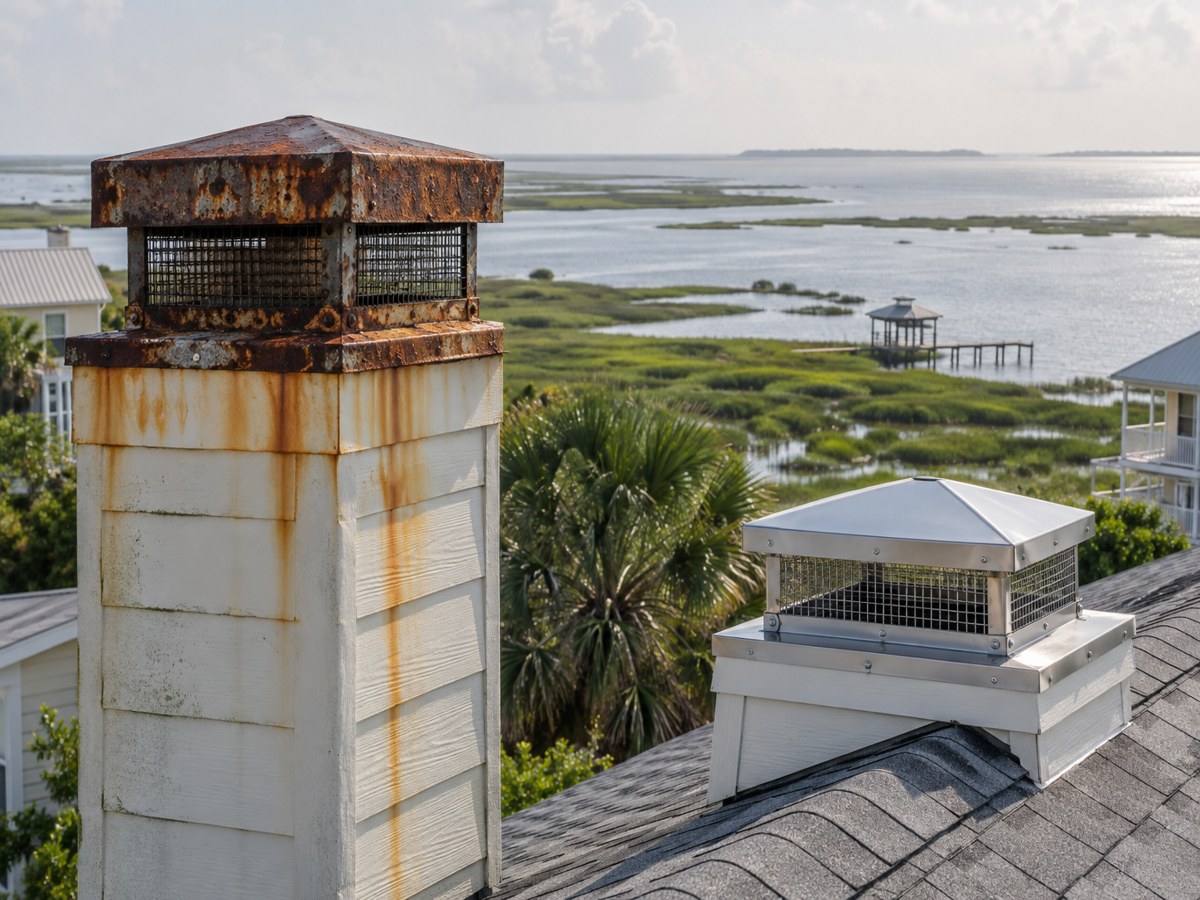
Salt is hygroscopic — it holds moisture against whatever it lands on — and Gulf air is already carrying plenty. Together they corrode galvanized metal far faster than either would alone, so caps, chase covers, flashing and arrestor mesh all need to be stainless. Tropical wind adds uplift, which makes how a part is fixed as important as what it is made of.
Why humidity is the multiplier
Inland, metal is wet after rain and then dries. On the coast it is damp most of the time, which means corrosion runs continuously rather than in episodes.
That is why a galvanized chase cover from Galveston through Beaumont can be perforating in a handful of years rather than fifteen. The visible result is rust streaking down the siding, and the usual misreading is that the chimney is failing — it is the lid on top failing and the wall is what the runoff lands on.
Masonry suffers differently. It never fully dries, so mortar loses its binder faster and anything embedded in it corrodes and expands.
Stainless throughout, fixings included
A stainless cover held with plated screws fails at the screws. Ask about the fasteners.
Breathable products only
On masonry that stays damp, a film-forming sealant traps moisture that has nowhere to go. A breathable siloxane repellent on sound masonry is the right product; a sealed surface is actively harmful here.
Storm uplift
Tropical wind puts direct lift on anything standing above the roof. A cap or cover that is resting rather than fixed becomes a cap or cover that is gone.
An open flue after a storm then takes rain for weeks or months before anyone notices, and in this climate that water does not dry out of the chase or the masonry.
Ask how it will be secured
Clamped to the flue tile or mechanically fixed into the crown, not friction-fitted. It is a specification question and it costs nothing to ask.
Check after every named storm
Cap and chase cover still present and secure, flashing intact, no debris in the flue. It is a two-minute look from the ground with a phone camera and it catches the open flue before a season of rain has gone down it.
What to do after a roof replacement
Gulf coast roofs get replaced after storms, often at volume and at speed, and the chimney flashing is the detail that gets rushed.
If your roof has been redone on a claim, photograph the flashing from the ground. If what you see is a black smear of mastic where the chimney meets the roof rather than stepped metal let into the mortar, raise it with the roofer while the workmanship warranty is still live. It is a far easier conversation inside the warranty than after it.
Need this done?
Coastal Chimney Protection across Texas
Free to use, no obligation — we never charge you.
Frequently asked questions
How far inland does salt matter?
Further than most expect, and storms carry it well inland. Anywhere in the coastal counties, specify stainless.
Is stainless worth the extra?
On the Gulf coast it is not really a choice — galvanized may give you a few years against decades for stainless, and the labor to fit either is identical.
What should we check after a hurricane?
Cap and chase cover present and secure, flashing intact, no debris in the flue, and the attic around the chimney penetration after the next heavy rain. An open flue is the most common post-storm finding.
Chimney services near you
- Houston
- San Antonio
- Dallas
- Austin
- Fort Worth
- El Paso
- Arlington
- Corpus Christi
- Plano
- Lubbock
- Irving
- Amarillo
- Garland
- Laredo
- Frisco
- McKinney
- Grand Prairie
- Killeen
- Brownsville
- Waco