Chimney guides
Chase Covers: The Most Common Texas Chimney Repair
If you live in a Texas house built since about 1980, what you have on the roof is probably not a chimney in the masonry sense at all.
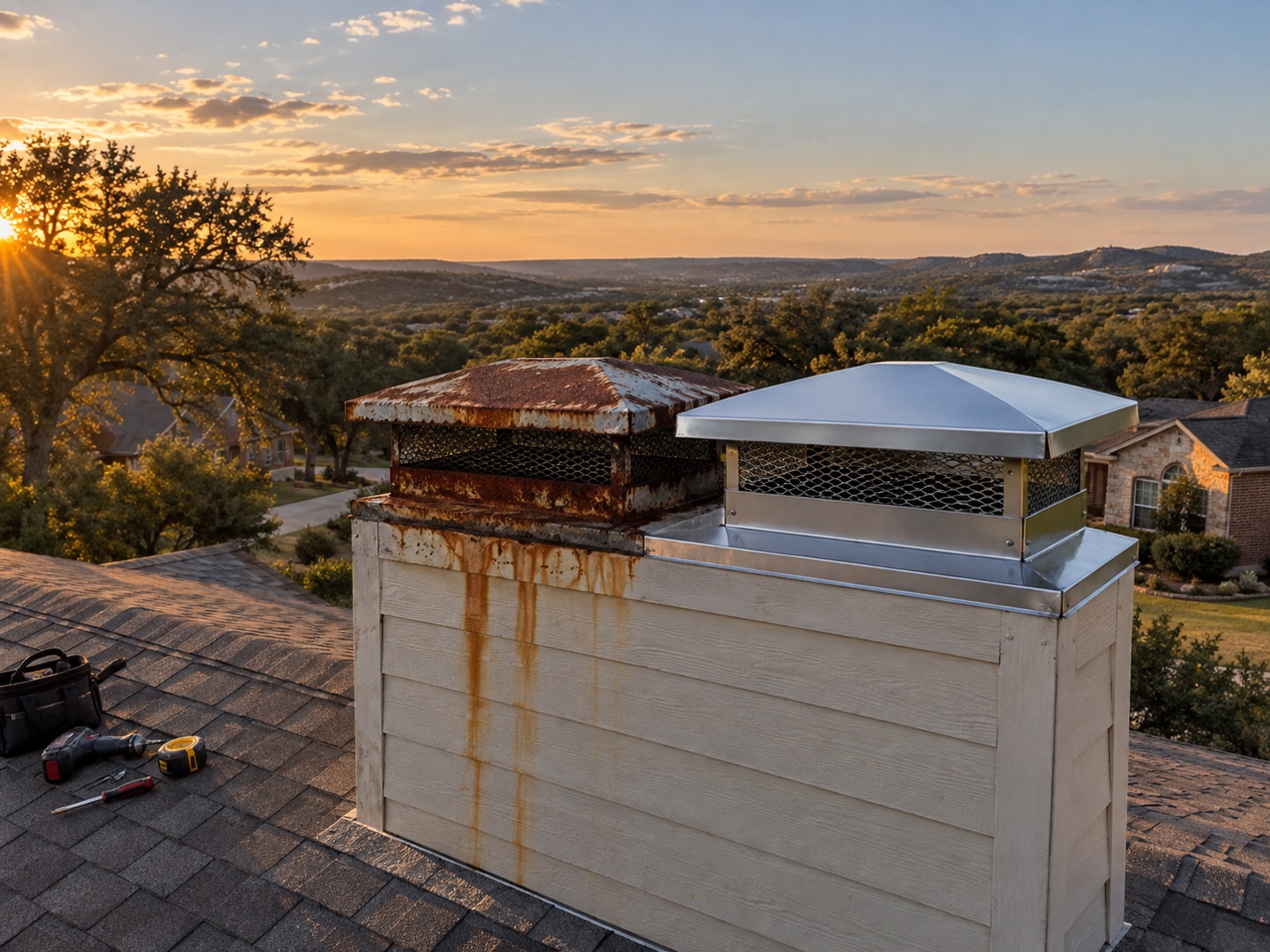
Short answer
It is a framed chase, clad to match the house, closed at the top by a sheet-metal cover with a collar around the flue pipe. Builders fit flat galvanized covers because they are the cheapest option available. Flat means water stands in the middle rather than running off, and standing water corrodes galvanized steel from the top down until it perforates. A stainless cover with a cross-break is the permanent replacement.
Why the original fails
Two design faults, both chosen for cost.
The first is the material. Galvanized steel relies on a sacrificial zinc coating, and under standing water that coating goes quickly. On the Gulf coast, where salt and permanent humidity are added, it goes faster still.
The second is the shape. A flat panel holds a shallow pool of water in the middle after every rain. That is the worst possible condition for galvanized steel, and it is exactly where these covers perforate.
What a cross-break does
It is a shallow ridge pressed into the sheet so the surface is not flat and water is forced to the edges and off. Combined with stainless rather than galvanized, it removes both failure mechanisms at once.
The collar leaks separately
The cover has to seal where the flue pipe passes through it. A proper collar with a storm seal does that. A bead of silicone does not survive a Texas summer, and it is where a lot of otherwise decent covers leak.
The rust streaks are the symptom, not the problem
Orange streaking down the siding or stucco is what people call about, and by then the cover has been holding water for years and has probably already perforated.
That matters because the visible staining is cosmetic and what has been happening inside the chase is not. Water entering a framed chase wets framing and insulation with no way to dry. Replacing the lid over rotted framing solves half the problem.
Look inside before recovering
Worth opening up enough to see the framing at the top of the chase, particularly if the staining has been there a while.
White staining is something else
If the streaking is white and chalky rather than orange, that is efflorescence on masonry — mineral salts carried out by water moving through brick. Different finding, different cause.
Wind is the other Texas factor
Storm wind puts direct uplift on anything standing proud of a roof. A cover that is merely resting becomes a cover that is gone, and an open chase then takes rain straight into the framing for however long it takes anyone to notice.
So ask how it will be secured, not only what it is made of. Mechanically fixed or clamped, not friction-fitted. And after any significant storm, a two-minute look at whether the cover and cap are still there is worth doing.
Need this done?
Chase Cover Replacement across Texas
Free to use, no obligation — we never charge you.
Frequently asked questions
Are covers made to measure?
Yes. Chases vary in size and in how many flues pass through, so covers are fabricated from measurements taken on the roof. That is also why an accurate quote needs someone up there first.
Can a cover be patched?
Temporarily. Once it has perforated the metal is thin everywhere, so a patch just moves where the next hole appears.
Does the cap go on the cover?
They are separate parts. The cover closes the top of the chase; the cap sits over the flue opening with mesh. Both corrode at the same rate and both are usually replaced in one visit.
Chimney services near you
- Houston
- San Antonio
- Dallas
- Austin
- Fort Worth
- El Paso
- Arlington
- Corpus Christi
- Plano
- Lubbock
- Irving
- Amarillo
- Garland
- Laredo
- Frisco
- McKinney
- Grand Prairie
- Killeen
- Brownsville
- Waco