Chimney guides
Gas Log Sets: The Appliance Nobody Services
Most Texas fireplaces are gas, and most Texas gas fireplaces have never been touched since the day they were installed.
Short answer
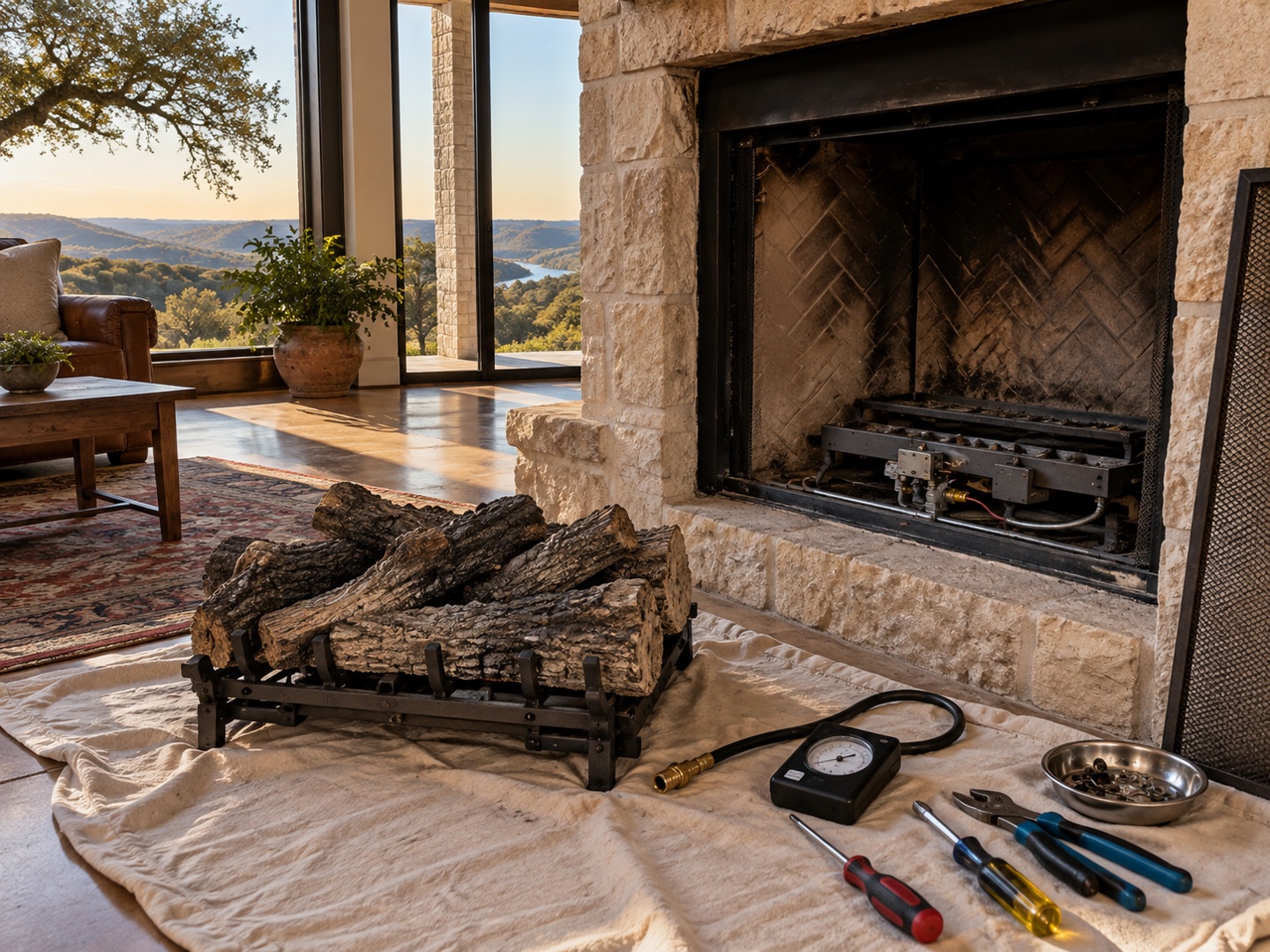
A gas log set is an appliance like any other and needs annual service: burner ports cleared, pilot assembly and thermocouple cleaned, gas pressure checked against the appliance rating with a manometer, venting inspected, and on a direct-vent unit the glass gasket checked. The most common faults are a blocked pilot orifice, dust and spider webbing in the venturi, and a damper clamp nobody remembers.
What annual service actually covers
None of this is visible from the room, which is why these appliances get skipped.
Burner ports and the venturi
They block with dust, lint and spider webbing. Gas appliances attract a particular spider that nests in the venturi tube, and in Texas it is a genuinely common cause of a set that will not light or runs unevenly.
Pilot assembly and thermocouple
Both collect the same debris. A thermocouple that has degraded will not hold the gas valve open, which is the classic "pilot will not stay lit" complaint, and it is a routine part rather than a new appliance.
Gas pressure
Checked with a manometer against the rating on the appliance plate. Too low and it will not perform; too high and it sooting. This is the check most often skipped and it needs an instrument rather than a judgement.
Venting and, on direct-vent, the glass gasket
The gasket around the sealed glass front is what keeps combustion products out of the room. It degrades with heat cycling. It is a service item, not a permanent fitting.
What the flame is telling you
A vented gas log set is designed to burn with a mostly yellow, lazy flame — that is what makes it look like wood. So "yellow" on its own is not a fault.
What is a fault: soot appearing on the logs, the glass or the surround; a flame that lifts off the burner; black deposits on the firebox walls. Those are combustion problems and they are worth acting on immediately rather than at the end of the season, because incomplete combustion is how carbon monoxide is produced.
Log placement is specified, not decorative
This surprises people. The log layout comes from the manufacturer and it is designed so the flame does not impinge on a log. Rearranging them for looks is a very common cause of sooting. If someone has moved them, the manual has a diagram.
The damper clamp everybody forgets
A vented gas log set requires the damper to be permanently fixed part- open, so combustion products cannot be trapped in the room. Installers do that with a clamp, and a decade later nobody remembers it is there.
Two consequences. First, it is correct for the appliance and it is also a permanent opening in a house that runs air conditioning eight months of the year — that is conditioned air going up the flue continuously. Second, if a previous owner or a sweep removed the clamp, the damper can now close, and on a vented set that is dangerous.
So it is worth checking that the clamp is still present, and worth knowing that a top-sealing damper is not an option while a vented set is fitted.
Need this done?
Gas Fireplace Service across Texas
Free to use, no obligation — we never charge you.
Frequently asked questions
How often does a gas fireplace need servicing?
Annually, like any gas appliance, even if it is barely used. It is the most commonly skipped service in Texas housing.
The pilot will not stay lit. What is it?
Usually a dirty or failing thermocouple, or a blocked pilot orifice. Both routine service items.
Do gas fireplaces need the chimney swept?
They need the flue inspected rather than brushed. Little residue, but nesting, debris and a corroding chase cover all still happen.
Chimney services near you
- Houston
- San Antonio
- Dallas
- Austin
- Fort Worth
- El Paso
- Arlington
- Corpus Christi
- Plano
- Lubbock
- Irving
- Amarillo
- Garland
- Laredo
- Frisco
- McKinney
- Grand Prairie
- Killeen
- Brownsville
- Waco